Ethena USDe (USDe): How USDe Maintains Its Dollar Reference
USDe is Ethena protocol's crypto-backed synthetic dollar. It targets a dollar reference through backing assets, derivatives hedges, liquid stable allocations and operational risk controls; it is not a bank deposit and does not promise that every secondary market trade executes at one dollar. This page focuses on how USDe Maintains Its Dollar Reference and the checks users need before choosing a network, redeeming or moving funds.
Understand USDe backing, redemption access and sUSDe risk before acquiring or staking the token.
Subject:
Ethena USDe
Market mode:
Snapshot Only
Fee asset:
ETH
Timezone:
UTC
This page does not audit reserves, confirm mint eligibility, quote redemption value or guarantee the peg.
Content ownership: BitcoinToolkit Editorial TeamTechnical references: Official protocol and developer documentation.Review approach: Technical explanations are checked against primary sources and updated when the network or asset changes.Last content review: Data integration last tested:
How USDe Maintains Its Dollar Reference
Backing value and offsetting derivatives positions are managed as one risk system.
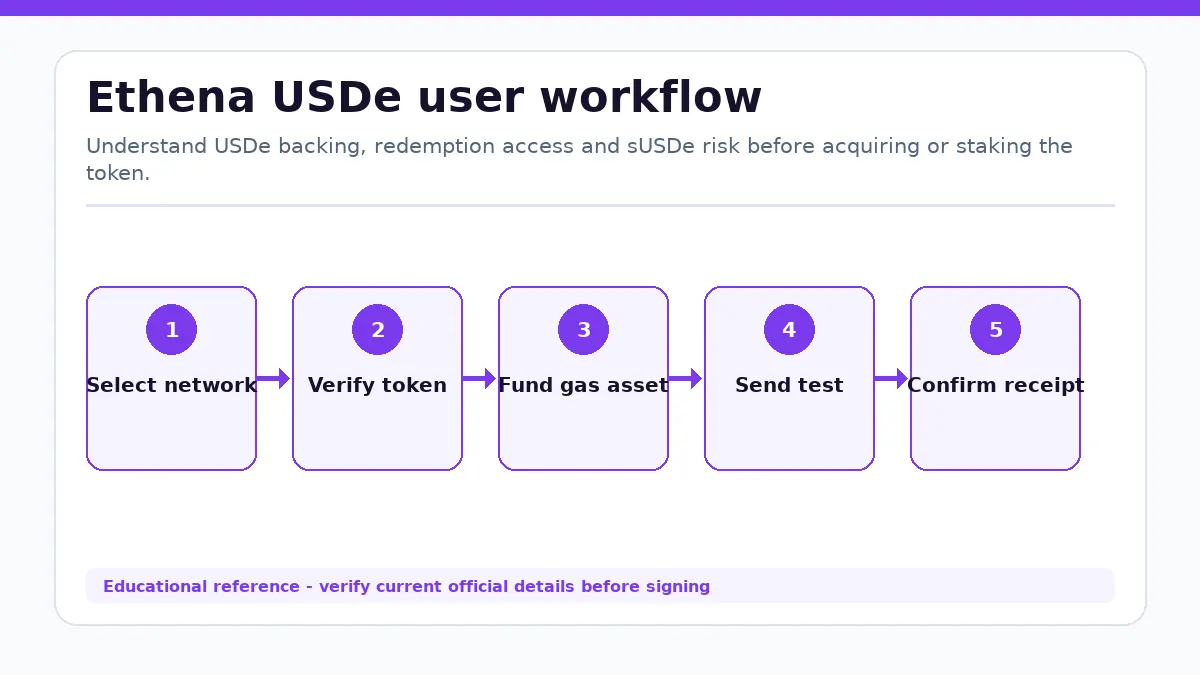
Ethena USDe workflow from the first user decision to a verified outcome.
Delta-neutral design with dynamic allocation
Ethena accepts supported backing assets from approved minters and opens short derivatives positions intended to offset their price exposure. The backing mix can include liquid stable assets and staked assets, with allocation adjusted according to liquidity, funding and risk conditions.
The hedge reduces directional exposure but introduces exchange, basis, funding, margin and operational risk. A delta-neutral target does not mean risk-free or perfectly stable. Persistent negative funding, dislocated collateral or failed counterparties can pressure revenue, backing access or market confidence.
Token transferability is broader than direct protocol access.
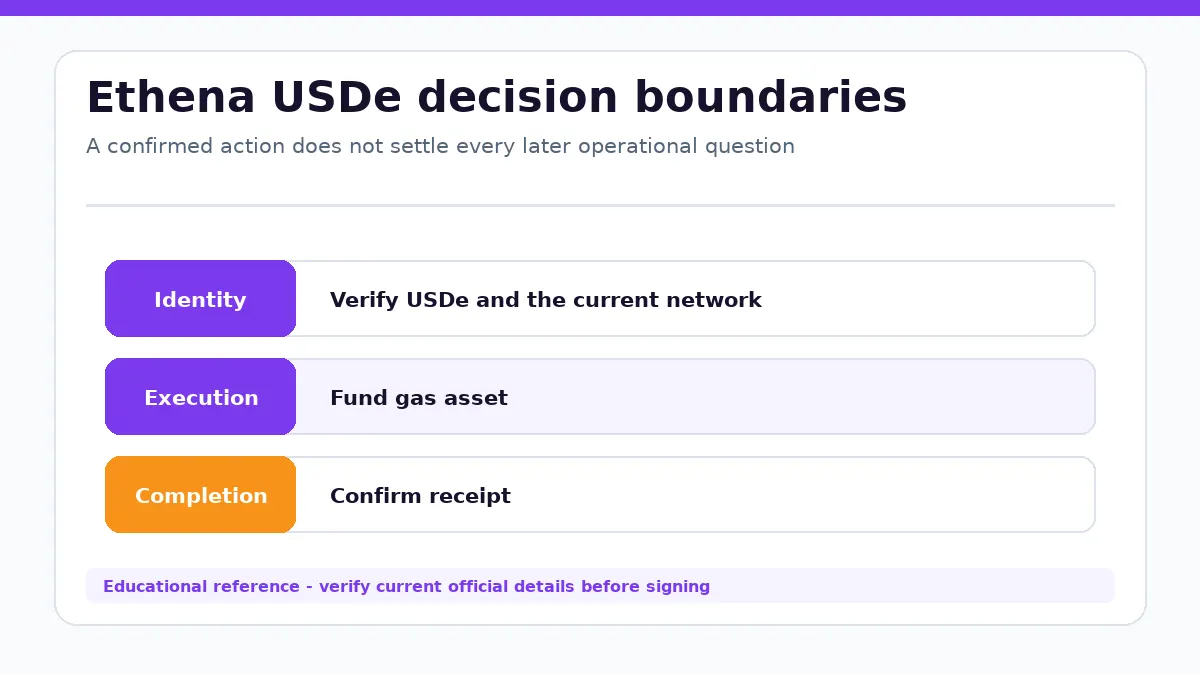
Ethena USDe confirmation does not settle every later operational question.
Whitelisted primary access and open secondary markets
Only approved wallets meeting current eligibility and jurisdiction rules can mint and redeem directly through Ethena. Quotes account for backing, hedge execution, gas and slippage. Other users can acquire or sell USDe through external liquidity venues, but that is not direct issuer redemption.
When secondary USDe trades away from its reference, eligible arbitrageurs may mint or redeem against protocol value. This mechanism depends on their access, market liquidity, custodian operations and execution capacity. A holder without direct access can face discounts, delays or platform counterparty risk.
USDe and sUSDe Are Different Positions
Staking changes liquidity and exposure in exchange for protocol distributions.
A receipt with a changing exchange rate
sUSDe is received by staking USDe in the designated contract. Protocol distributions can increase the amount of USDe represented by each sUSDe over time. The rate is variable and depends on protocol revenue and current rules rather than a guaranteed coupon.
Unstaking follows contract cooldown and liquidity conditions applicable at the time. sUSDe adds smart-contract, timing and market-price risk. ENA and sENA are separate governance tokens and should not be confused with the USDe staking receipt.
Ethena USDe Operating Context
Backing quality, custody and market access matter alongside the token contract.
What Ethena USDe users should verify and why this design differs
Keep ETH for Ethereum transactions and inspect approvals.
Assess funding, exchange, custodian, collateral, stable-asset, smart-contract and liquidity risks. Read current attestations and terms without treating them as a guarantee. A successful on-chain transfer proves token movement, not that backing can be accessed immediately or that a secondary market will hold the dollar reference.
Verify USDe and sUSDe separately.
Know whether direct redemption is available.
Review backing and counterparty risks.
Keep host-chain gas for transactions.
Ethena USDe Transfers FAQ
What pays transaction fees when using Ethena USDe?
Host-network gas asset (ETH) pays the applicable network fee. Verify the selected network before signing because a later approval, bridge, claim or exit can require another transaction.
How does Ethena USDe differ from Ripple USD?
Compare fees, execution, security and user workflow before choosing between Ethena USDe and Ripple USD. Compare the exact network, permissions, fee path, final state and exit requirement rather than token price alone.
Known Limitations
Backing composition and counterparties change.
The page does not verify eligibility or reserves.
Secondary liquidity can deviate from the reference.
Market Data Methodology
The page uses a CoinGecko aggregated USDe/USD snapshot. No exchange chart is rendered for this entity.
Market Snapshot Source
CoinGecko aggregated market data (USDe/USD)
Cache
Snapshot cache is approximately 60 seconds.
Failure Handling
Verified cached data is labeled Cached or Delayed. Missing values remain unavailable.