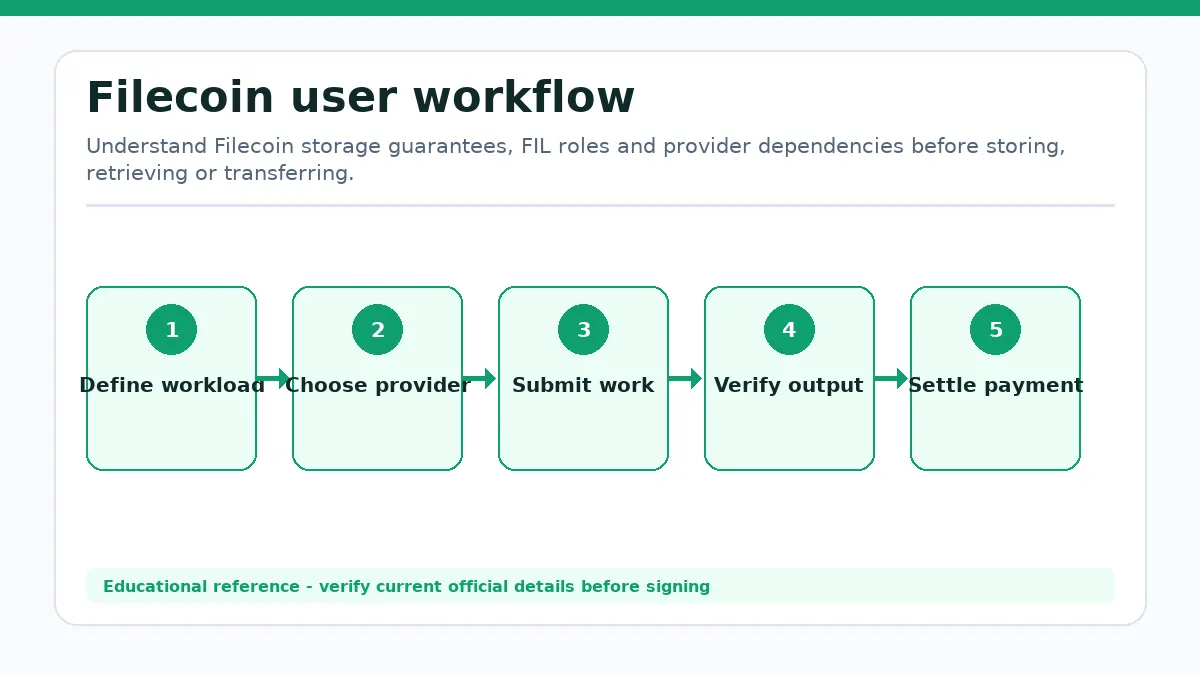
Filecoin is a peer-to-peer storage network that uses economic incentives and cryptographic proofs to coordinate storage providers and clients. FIL is its native currency for blockchain fees, provider collateral, rewards and storage-related payments under negotiated deal terms. This page focuses on how Filecoin Storage Deals Work and the checks users need before integrating the service or using the token.
Understand Filecoin storage guarantees, FIL roles and provider dependencies before storing, retrieving or transferring.
Subject:
Filecoin
Market mode:
Snapshot Only
Fee asset:
FIL
Timezone:
UTC
This page does not choose a provider, price a deal, guarantee data retrieval, estimate provider profitability or audit stored content.
Content ownership: BitcoinToolkit Editorial TeamTechnical references: Official protocol and developer documentation.Review approach: Technical explanations are checked against primary sources and updated when the network or asset changes.Last content review: Data integration last tested:
How Filecoin Storage Deals Work
The blockchain coordinates commitments and proofs, while clients and providers negotiate practical service terms.
Filecoin workflow from the first user decision to a verified outcome.
From agreement to sealed sector
A client selects a storage provider and agrees on data, price, duration and other terms. Deal negotiation and data transfer can begin off-chain. The provider places data into a sector, seals it and publishes the required on-chain information so the network can recognize the storage commitment.
Providers can set their own commercial terms, and some onramps abstract the deal process. A valid deal does not mean every application stores a plain readable copy or provides instant retrieval. Encryption, replication count, geographic distribution and retrieval service must be planned separately by the client.
Filecoin Risks Before Completion
Proof of storage verifies commitment over time, not the meaning or quality of the data.
PoRep at onboarding and PoSt during storage
Proof of Replication shows that a provider created a unique sealed copy of data in a sector. Proof of Spacetime requires continuing evidence that the provider still holds the sealed data over the deal period. WindowPoSt checks ongoing sector availability, while WinningPoSt participates in block production.
Missed proofs can create faults and financial penalties. The protocol verifies storage commitments, but it does not judge whether the file is useful, lawful, correctly encrypted or replicated across independent failure domains. Clients should preserve local metadata and use multiple providers when their durability requirements demand it.
FIL, Gas, Collateral and Finality
One native asset supports message execution and several storage-economy incentives.
Network value and provider obligations
FIL pays blockchain message gas and can be used for storage payments. Providers lock collateral and receive rewards under network rules, while penalties can reduce balances when obligations are not met. Current provider economics can also include protocol fees and debt conditions, so operating a provider is not ordinary proof-of-work mining.
Filecoin groups blocks into tipsets and selects a heaviest chain under Expected Consensus. Soft finality is configured over many epochs, so applications choose confirmation policies based on value and risk. A message inclusion does not prove that an off-chain data transfer or later retrieval completed successfully.
Filecoin Storage and Retrieval Checks
Keeping a CID is necessary, but reliable retrieval needs provider and indexing preparation.
Plan availability beyond the deal record
Keep the content identifier, deal information, encryption keys and provider details. Confirm whether the provider advertises to the indexing network and which retrieval protocols are supported. Consider independent replicas and a hot IPFS copy for latency-sensitive data, because Filecoin and IPFS are complementary rather than interchangeable guarantees.
For FIL transfers, verify mainnet address format, destination support and required confirmations. For storage, assess provider reputation, power, fault history, terms and retrieval path. Never upload unencrypted sensitive data on the assumption that a decentralized deal automatically provides confidentiality or permanent public availability.
Preserve the CID and encryption keys.
Use independent replicas when needed.
Plan retrieval as well as storage.
Separate on-chain confirmation from data delivery.
Providers seal data into sectors, submit Proof of Replication when onboarding storage and continue submitting Proof of Spacetime. Expected Consensus weights eligible block production by storage power, while deals, retrieval and IPFS availability remain related but distinct workflows.
A Filecoin payment can settle even when useful work, storage, availability or output quality has not been verified for the user's requirement. FIL is the market-profiled asset. FIL pays message gas and supports storage payments and provider collateral.
What Filecoin users should verify and why this design differs
Deal prices and provider performance vary. The page does not verify data durability or confidentiality.
For Filecoin, the practical sequence is Define workload, Choose provider, Submit work, Verify output, Settle payment. Confirm the official destination and current network, then inspect the final balance, position, receipt or documented exit state that actually completes the task: Understand Filecoin storage guarantees, FIL roles and provider dependencies before storing, retrieving or transferring.
Filecoin Resource use FAQ
Does a Filecoin proof guarantee instant retrieval?
No. Proofs verify storage commitments; retrieval availability and speed depend on providers and the retrieval path.
What is FIL used for?
FIL pays network gas and participates in storage payments, provider collateral and protocol rewards.
Is Filecoin the same as IPFS?
No. IPFS provides content addressing and transfer, while Filecoin adds economic incentives and verifiable storage commitments.
What pays transaction fees when using Filecoin?
Filecoin (FIL) pays the applicable network fee. Verify the selected network before signing because a later approval, bridge, claim or exit can require another transaction.
Known Limitations
Deal prices and provider performance vary.
The page does not verify data durability or confidentiality.
Protocol fees and provider rules can change.
Market Data Methodology
The page uses a CoinGecko aggregated FIL/USD snapshot. No exchange chart is rendered for this entity.
Market Snapshot Source
CoinGecko aggregated market data (FIL/USD)
Cache
Snapshot cache is approximately 60 seconds.
Failure Handling
Verified cached data is labeled Cached or Delayed. Missing values remain unavailable.