Pi Network is a Layer 1 payment and application network whose Open Network period began in February 2025, removing the earlier external-connectivity firewall. PI is its native mainnet currency; app mining balances, migrated mainnet balances and exchange-traded claims must not be treated as automatically identical. This page focuses on what Pi Open Network Changed and the checks users need before sending funds, paying fees or using the network.
Understand Pi Open Network and verify whether a balance, wallet or transfer is actually on Pi Mainnet.
Subject:
Pi Network
Market mode:
Snapshot Only
Fee asset:
PI
Timezone:
UTC
This page does not complete KYC, accelerate migration, validate an exchange, recover a passphrase or guarantee mainnet liquidity.
Content ownership: BitcoinToolkit Editorial TeamTechnical references: Official protocol and developer documentation.Review approach: Technical explanations are checked against primary sources and updated when the network or asset changes.Last content review: Data integration last tested:
What Pi Open Network Changed
External connectivity is now enabled, but the earlier migration process still affects individual balances.
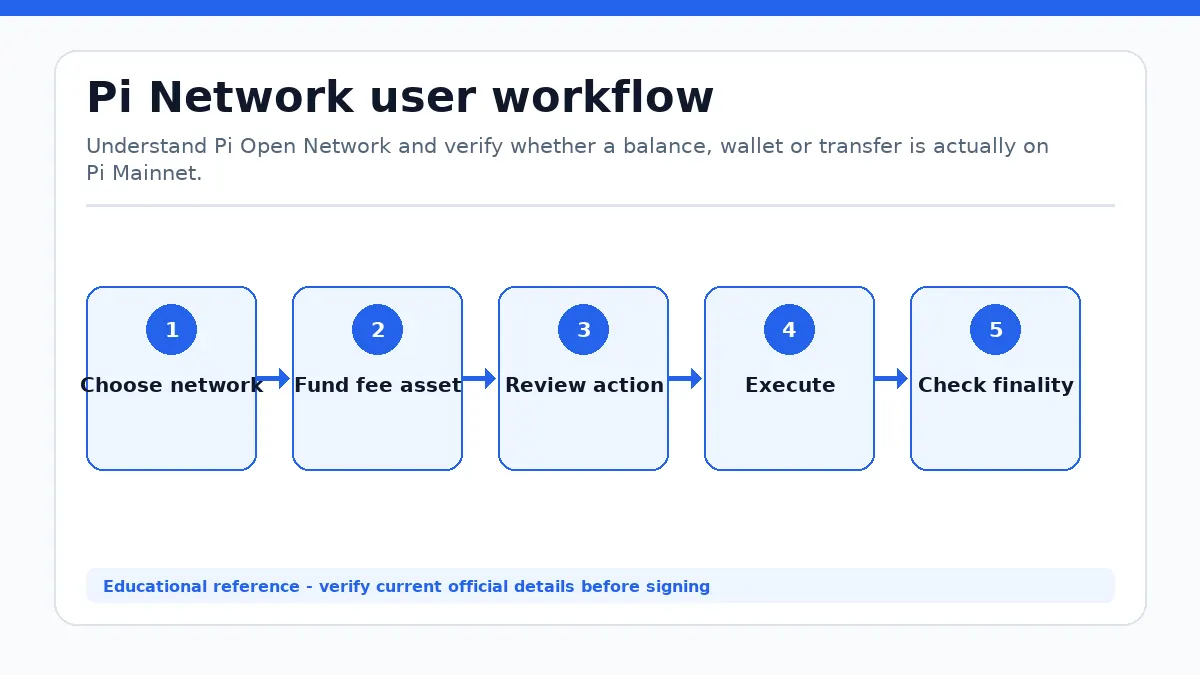
Pi Network workflow from the first user decision to a verified outcome.
Open connectivity is not automatic migration
Pi announced the launch of Open Network in February 2025. The change removed the Enclosed Network firewall and allowed nodes, wallets and services to connect with external systems. It did not convert every mobile mining balance into immediately transferable mainnet PI.
Each user must satisfy the current Mainnet Checklist and migration process applicable to the account. Pending, unverified, locked or unmigrated amounts can remain different from the spendable wallet balance. A market ticker shown by a venue should not be used as proof that a particular in-app amount is on-chain.
The wallet passphrase and migrated ledger balance determine self-custodied access.
Protect the irreversible credential
A Pi Mainnet wallet is controlled by its passphrase. The passphrase is not an account password that support can reset, and anyone who obtains it can control the wallet. Users should create and access wallets only through official Pi applications and keep the credential offline.
Migration can include transferable balance calculations, KYC status, account checks and lockup settings. Transfers between users inside earlier application contexts are not necessarily equivalent to mainnet transactions. Confirm the transaction in a mainnet explorer or official wallet history before treating funds as externally transferable.
How PI Transactions Reach Consensus
Pi uses federated trust relationships rather than proof-of-work mining or EVM validators.
Nodes and quorum relationships
Pi documentation builds on the Stellar Consensus Protocol model, where nodes choose trusted quorum relationships and agreement emerges from overlapping slices. Mobile tapping is a distribution and participation activity; it is not proof-of-work block production performed by a phone.
A mainnet transfer uses PI as the value and fee asset. Transaction acceptance still depends on a valid destination, sequence and network state. Applications and exchanges can impose additional minimums, memos, confirmation policies or regional requirements beyond the base protocol.
Fake migration help and unsupported exchange routes are the largest avoidable risks.
Verify before exposing credentials or sending
Use the official Safety Center and app links, never enter a wallet passphrase into a KYC, exchange or support form, and verify that any destination explicitly supports Pi Mainnet. Send a small test where appropriate and include a required memo exactly as shown.
Do not pay an unsolicited party to accelerate KYC or migration. Distinguish spendable mainnet PI from locked, pending or application balances. Confirm local legal and platform restrictions, and remember that Open Network connectivity does not certify every external exchange, token, bridge or service using the Pi name.
Pi uses a federated-consensus design derived from the Stellar Consensus Protocol, with nodes forming trust relationships. Mainnet wallets submit PI transactions and pay PI-denominated fees, while migration from the mobile application requires the network account, identity and checklist processes documented by Pi.
A Pi Network transaction can execute successfully while the application state, contract permission or later exit remains wrong for the user's goal. PI is the market-profiled mainnet asset. PI covers protocol transaction fees on Pi Mainnet.
What Pi Network users should verify and why this design differs
Migration and eligibility status are account-specific. The page cannot recover a wallet passphrase.
For Pi Network, the practical sequence is Choose network, Fund fee asset, Review action, Execute, Check finality. Confirm the official destination and current network, then inspect the final balance, position, receipt or documented exit state that actually completes the task: Understand Pi Open Network and verify whether a balance, wallet or transfer is actually on Pi Mainnet.
Pi Network Network use FAQ
Is Pi Network open to external connectivity?
Yes. Pi announced Open Network in February 2025, but users still need migrated mainnet balances for on-chain transfers.
Can Pi support recover a wallet passphrase?
No. A self-custodied wallet passphrase must be protected by its owner and should never be shared.
Does mobile mining create blocks?
No. Pi mobile participation is not proof-of-work mining; network consensus is node based.
What pays transaction fees when using Pi Network?
Pi (PI) pays the applicable network fee. PI covers protocol transaction fees on Pi Mainnet. Verify the selected network before signing because a later approval, bridge, claim or exit can require another transaction.
Known Limitations
Migration and eligibility status are account-specific.
The page cannot recover a wallet passphrase.
External service support can change.
Market Data Methodology
The page uses a CoinGecko aggregated PI/USD snapshot. No exchange chart is rendered for this entity.
Market Snapshot Source
CoinGecko aggregated market data (PI/USD)
Cache
Snapshot cache is approximately 60 seconds.
Failure Handling
Verified cached data is labeled Cached or Delayed. Missing values remain unavailable.