Ethereum Classic (ETC): How ETC Transactions and Gas Work
Ethereum Classic is an independent EVM-compatible Layer 1 that preserved the original Ethereum chain history after the 2016 DAO fork. ETC is its native currency and gas asset, while proof-of-work miners produce blocks and secure the current chain. This page focuses on how ETC Transactions and Gas Work and the checks users need before sending funds, paying fees or using the network.
Understand how Ethereum Classic transactions, gas and proof-of-work confirmations differ from Ethereum.
Subject:
Ethereum Classic
Market mode:
Snapshot Only
Fee asset:
ETC
Timezone:
UTC
This page does not prescribe a confirmation count, estimate mining profitability, audit a contract or guarantee exchange crediting.
Content ownership: BitcoinToolkit Editorial TeamTechnical references: Official protocol and developer documentation.Review approach: Technical explanations are checked against primary sources and updated when the network or asset changes.Last content review: Data integration last tested:
How ETC Transactions and Gas Work
Ethereum-style account rules apply, but the fee currency and network state are Ethereum Classic specific.
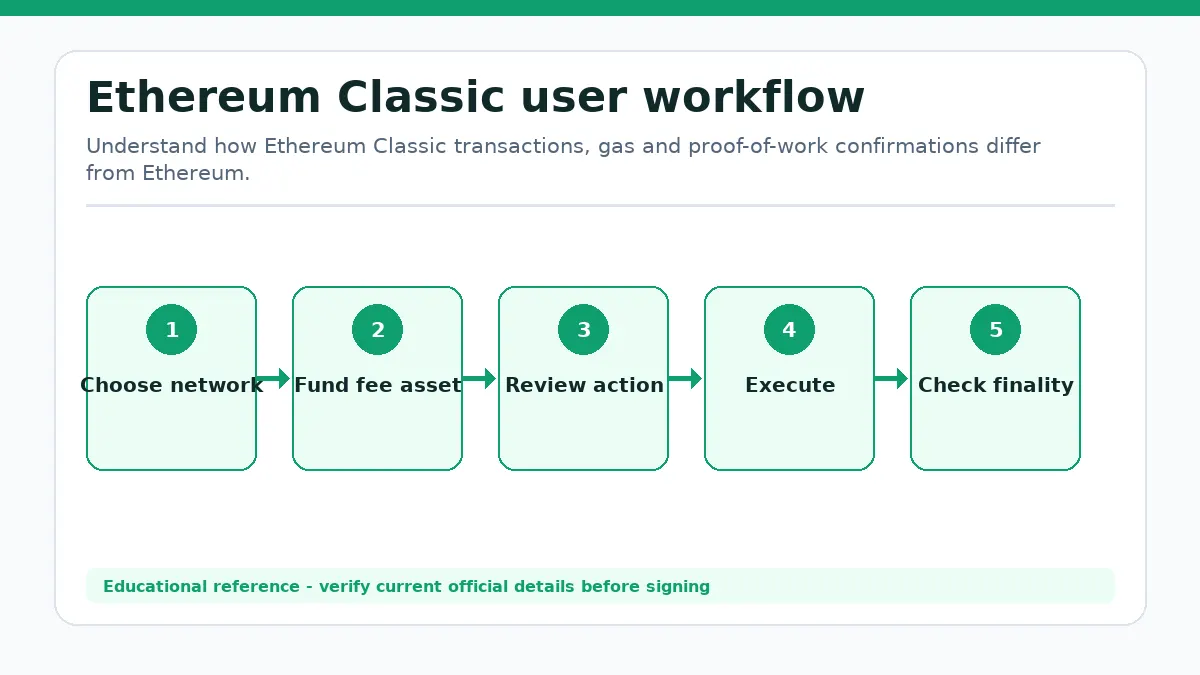
Ethereum Classic workflow from the first user decision to a verified outcome.
Nonce, gas and contract execution
An externally owned account signs a transaction containing a nonce, destination, value, gas limit and fee terms. The nonce orders transactions from that account. ETC pays the execution cost whether the action transfers native value or calls a smart contract.
Gas used reflects executed computation and storage changes. A contract call can revert after consuming gas, while unused gas within the limit is not charged. Fee conditions depend on Ethereum Classic demand and client behavior, so an Ethereum gas estimate should not be copied without querying an ETC-compatible node or wallet.
Where Ethereum Classic Differs for Users
Shared history and compatible address formats do not make ETC and ETH interchangeable.
One pre-fork history, two current ledgers
Ethereum Classic continued the original chain after the DAO-related fork, while Ethereum followed the state-changing fork and later moved to proof of stake. Each network now has independent consensus, assets, contracts, balances and application activity. A transaction broadcast to one does not appear on the other.
Both networks use familiar hexadecimal addresses and EVM tooling. That compatibility creates operational risk: a wallet may accept the same address text while an exchange or application supports only one network. Users must select Ethereum Classic explicitly and verify ETC deposit support rather than relying on address appearance.
ETC settlement confidence grows as miners extend the chain.
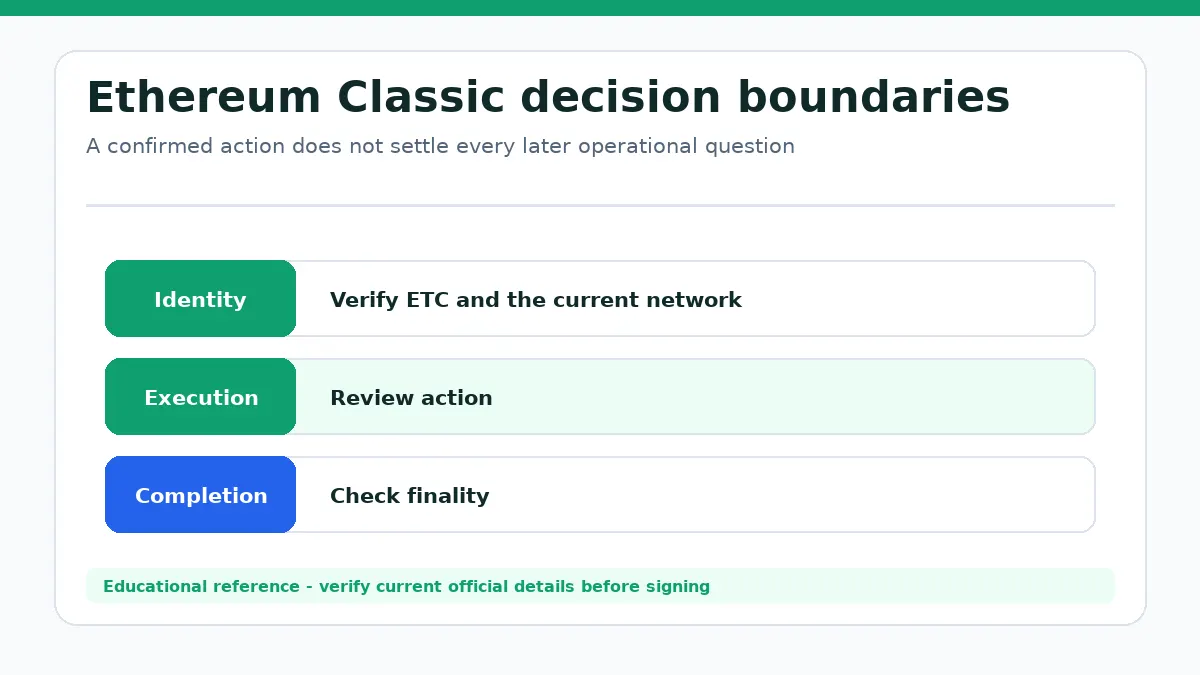
Ethereum Classic confirmation does not settle every later operational question.
Probabilistic rather than checkpoint finality
Miners compete to produce valid blocks and the network follows its proof-of-work fork-choice rules. Older transactions become more costly to reorganize as additional work accumulates, but there is no single universal confirmation number that suits every transaction value or recipient risk policy.
Ethereum Classic has experienced majority-hash reorganizations in its history, which is why exchanges can require more confirmations than a personal wallet. A first included block is useful evidence, not an irreversible guarantee. Recipients should follow their own risk threshold and verify that the transaction remains on the canonical chain.
Network selection and contract verification matter more than familiar EVM branding.
Prepare the correct chain
Confirm the wallet RPC, chain identifier, destination support and fee balance in ETC. For token transfers, verify the Ethereum Classic contract rather than an Ethereum contract with the same symbol. Send a small test to a new exchange route and wait for the recipient-defined confirmation threshold.
Developers should verify client and opcode compatibility, compiler targets, oracle availability, bridge assumptions and network-specific deployment addresses. A contract deployed on Ethereum is not automatically present on Ethereum Classic. Treat bridges, wrapped assets and third-party RPC endpoints as additional dependencies rather than properties of the base ETC network.
Accounts sign Ethereum-style transactions with a nonce, gas limit and gas price. Miners order valid transactions into blocks under proof of work, and applications wait for additional confirmations because chain reorganization risk declines probabilistically rather than through proof-of-stake finality checkpoints.
A Ethereum Classic transaction can execute successfully while the application state, contract permission or later exit remains wrong for the user's goal. ETC is the market-profiled asset. ETC pays gas for transfers and smart-contract execution.
What Ethereum Classic users should verify and why this design differs
Confirmation policies vary by recipient. The page does not audit contracts or bridges.
For Ethereum Classic, the practical sequence is Choose network, Fund fee asset, Review action, Execute, Check finality. Confirm the official destination and current network, then inspect the final balance, position, receipt or documented exit state that actually completes the task: Understand how Ethereum Classic transactions, gas and proof-of-work confirmations differ from Ethereum.
Ethereum Classic Network use FAQ
Is Ethereum Classic the same network as Ethereum?
No. They share early history but now have separate consensus, assets and state.
What pays Ethereum Classic gas?
ETC pays gas for native transfers and smart-contract execution.
Are ETC transactions instantly final?
No. Proof-of-work confirmation confidence increases as additional blocks and cumulative work build.
Known Limitations
Confirmation policies vary by recipient.
The page does not audit contracts or bridges.
Network fees and mining conditions change.
Market Data Methodology
The page uses a CoinGecko aggregated ETC/USD snapshot. No exchange chart is rendered for this entity.
Market Snapshot Source
CoinGecko aggregated market data (ETC/USD)
Cache
Snapshot cache is approximately 60 seconds.
Failure Handling
Verified cached data is labeled Cached or Delayed. Missing values remain unavailable.