World is an identity and financial network ecosystem. WLD is an ERC-20 token originally deployed on Ethereum, with World Chain now documented as the main venue for user access and use; World ID and World Chain are separate components that do not turn WLD into a proof of personhood. This page focuses on where WLD Exists and What Pays Gas and the checks users need before using the current asset or handling a legacy representation.
Verify which WLD representation a wallet is using and how World Chain fees and identity features relate.
Subject:
World
Market mode:
Snapshot Only
Fee asset:
ETH
Timezone:
UTC
This page does not determine World ID eligibility, regional WLD availability, grant entitlement or bridge safety.
Content ownership: BitcoinToolkit Editorial TeamTechnical references: Official protocol and developer documentation.Review approach: Technical explanations are checked against primary sources and updated when the network or asset changes.Last content review: Data integration last tested:
Where WLD Exists and What Pays Gas
A WLD ticker must be paired with its network and contract address.
World workflow from the first user decision to a verified outcome.
Ethereum origin and World Chain use
Official tokenomics identifies WLD as an ERC-20 token on Ethereum and lists World Chain as the main current venue for access and use. Optimism was the main venue before the World Chain transition and remains a supported representation. Other look-alike contracts or third-party bridges require separate verification.
World Chain uses Ethereum-compatible transaction fees. Product interfaces may sponsor fees for eligible verified users, making an action appear free to the sender. Sponsorship is an application policy, not a change to the protocol fee asset, and it may not cover every wallet, contract call or period of network use.
World Transaction and Fee Checks
The token, identity system and blockchain solve separate parts of the World ecosystem.
Do not use one component as proof of another
WLD is a fungible token with ecosystem and prospective governance roles. World ID provides privacy-oriented proof-of-human credentials, while World Chain executes transactions and applications. A wallet can hold WLD without having a World ID, and a verified World ID does not prove ownership of a particular wallet balance.
The World Foundation currently stewards parts of the protocol while describing progressive decentralization. Governance mechanisms may combine token-based and person-based participation in the future, but users should not assume that holding WLD presently grants access to every identity, grant or application function.
Moving WLD between chains changes the representation and adds route dependencies.
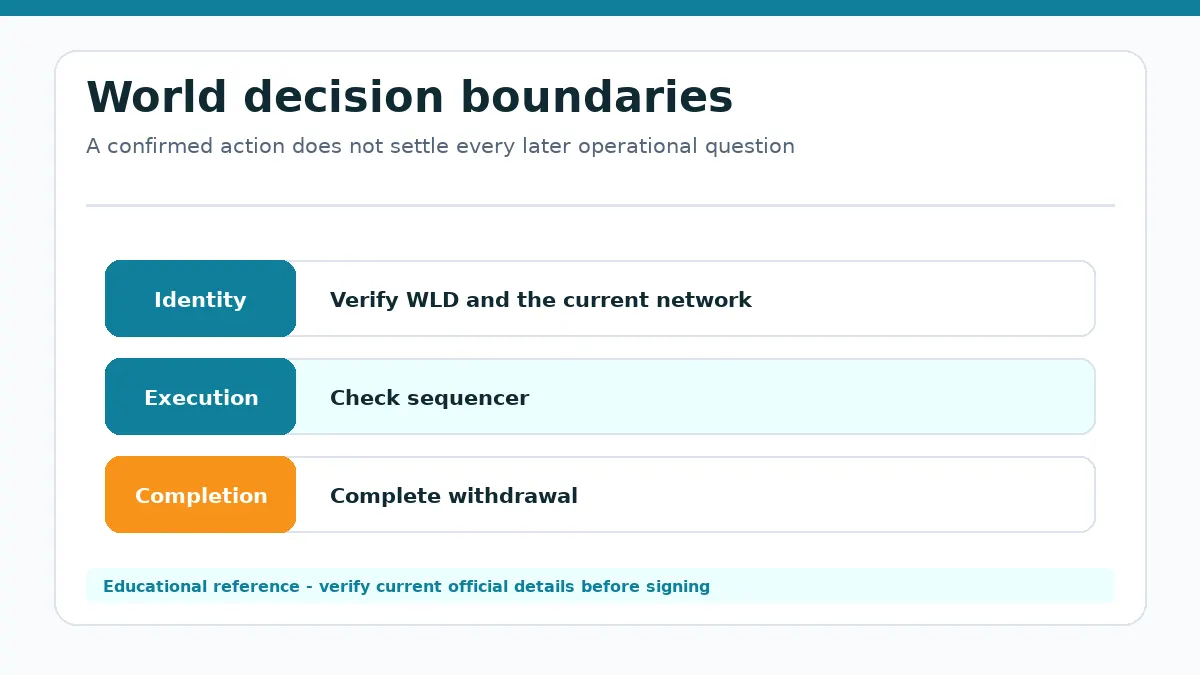
World confirmation does not settle every later operational question.
Confirm both ends before moving
The documented Superbridge path connects World Chain with Ethereum-compatible Superchain infrastructure. A bridge transaction can involve source confirmation, a message delay and destination execution. Third-party bridges may issue representations that are not controlled or guaranteed by the World Foundation.
WLD availability and grant access can be restricted by geography and terms. Exchange support also varies by network. Users should verify the receiving platform, official contract and bridge route, keep any required ETH, and avoid assuming that an address accepted on one EVM chain guarantees deposit support on another.
WLD Checks Before You Sign
Impersonation, wrong-network deposits and identity confusion are the main avoidable risks.
Verify the exact token and product action
Confirm the network, official WLD contract and destination support. Review whether the action is a token transfer, bridge, grant claim, identity proof or Mini App transaction. Keep identity recovery information separate from wallet seed phrases, and do not disclose sensitive identity data to a token website or unsolicited support account.
Check whether gas is sponsored and what happens if sponsorship fails. Use the official app and documentation for regional availability. Treat WLD market value, World ID verification and World Chain application access as different risk categories, and remember that a valid token transaction cannot prove that an identity or application claim is legitimate.
Match network and official WLD contract.
Identify whether gas is sponsored.
Use documented bridge routes.
Keep identity credentials and wallet secrets separate.
World Chain is an OP Stack Layer 2 in the Superchain ecosystem. WLD can exist as canonical or bridged representations across Ethereum, World Chain and Optimism, while fee sponsorship may cover eligible transactions for verified users without changing the underlying gas accounting.
A World transaction can be accepted on the execution layer before settlement or a parent-chain withdrawal is complete. WLD is the market-profiled ecosystem token. ETH is the protocol fee currency even when verified users receive sponsored transactions.
What World users should verify and why this design differs
Regional availability and sponsorship rules can change. The page does not verify a World ID.
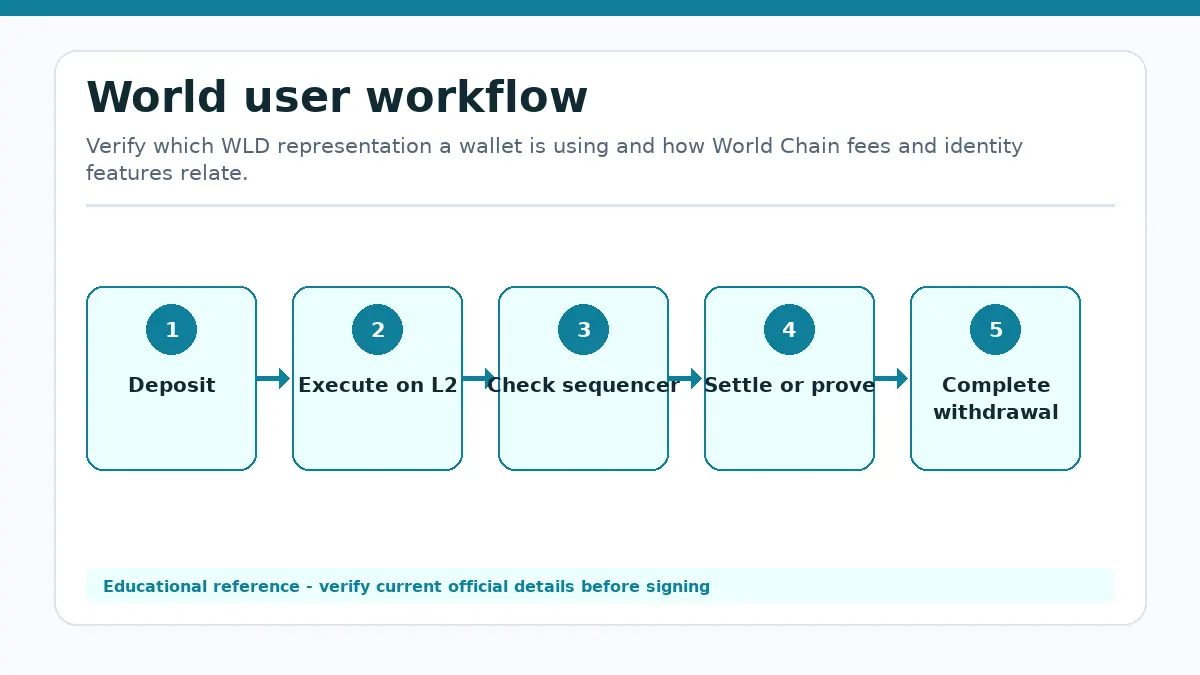
For World, the practical sequence is Deposit, Execute on L2, Check sequencer state, Settle or prove, Complete withdrawal. Confirm the official destination and current network, then inspect the final balance, position, receipt or documented exit state that actually completes the task: Verify which WLD representation a wallet is using and how World Chain fees and identity features relate.
World is an identity and financial network ecosystem.
World Layer 2 use FAQ
Is WLD the same as World ID?
No. WLD is a fungible token, while World ID is a proof-of-human credential system.
What pays World Chain transaction fees?
World Chain uses Ethereum-compatible gas accounting in ETH, though eligible transactions can be sponsored.
Where is WLD mainly used now?
Official tokenomics identifies World Chain as the main current venue, with Ethereum and Optimism representations also documented.
Known Limitations
Regional availability and sponsorship rules can change.
The page does not verify a World ID.
Third-party bridge representations need separate review.
Market Data Methodology
The page uses a CoinGecko aggregated WLD/USD snapshot. No exchange chart is rendered for this entity.
Market Snapshot Source
CoinGecko aggregated market data (WLD/USD)
Cache
Snapshot cache is approximately 60 seconds.
Failure Handling
Verified cached data is labeled Cached or Delayed. Missing values remain unavailable.